News

In Honor of Talk Like a Pirate Day!

In honor of Talk Like a Pirate Day, some original, literary, and Hollywood buccaneer language of captains exhorting their crews!

“Yes, follow me and doe not lye behind, for if I doe amise* You will all fair the worse for itt.”

—Captain Richard Sawkins, English buccaneer captain, landing himself first and leading the attack against the “stokadoes” on the río Puebla Nueva (in the modern district of Remedios, Panama) in 1680, as quoted by buccaneer “E. P.,” probably Edward Povey. Sawkins “went up corragiously with some brisk men with him, butt their was provided Mollattas and hunters with their launces which came to oppose him. He fierd his Pistole and shott downe one Musteese, the rest fiering and lodeing as fast as they could, but the Spaniards coming in upon them so fast that kill’d capt. Sawkins and 3 men more.” The buccaneers were forced to take to their heels.   * Probably amiss: to go amiss, to fail.

“Have a good courage. We must either defend ourselves like good soldiers, or lose our lives with all the riches we have gotten. Do as I shall do, who am your Captain. At other times we have fought with fewer men than we have in our company at present, and yet we have overcome greater numbers than there possibly can be in this town. The more they are, the more glory we shall attribute unto our fortune, and the greater riches we shall increase unto it.”

—Captain François L’Ollonois, aka Jean David Nau, prior to the attack on Gibraltar on Lake Maracaibo in 1666, as quoted by Alexandre Exquemelin, buccaneer-surgeon and buccaneer chronicler who likely sailed under him, from the 1684 English edition (Crooke) of The Buccaneers of America. The speech, while it might be authentic, might also be embellished, recreated and revised from poor memory, or even apocryphal, added after the fact for editorial emphasis. L’Ollonois, a bloody-minded buccaneer and murderer, was killed by Native Americans on the Darien coast in 1669, burned, and his ashes reportedly scattered to the wind.

“You are too experienced to not understand the peril we are running, and too brave to fear it. It is necessary here to be cautious of all yet to risk all, to defend and attack at the same time. Valor, deception, fear, and even despair must all be put to use on this occasion; where, if we fall into the hands of our enemies, nothing awaits us but all sorts of infamies, from the most cruel of torments to, finally, the end of life. We must therefore escape their barbarity; and to escape, we must fight.”

—Captain Laurens de Graff, Dutch buccaneer in the service of French flibustiers, prior to his fight against the Capitana and Almirante of the Armada de Barlovento in 1685, each ship twice the size of de Graff’s Neptune and throwing twice its weight in iron, as quoted (and perhaps embellished, and clearly edited) by Alexandre Exquemelin in the French edition of The Buccaneers of America. De Graff was later wounded in the action, but ordered his men to carry him back on deck when he noticed his ship’s guns slacking their fire. The Spanish men-of-war took enough of a beating that they fled the scene overnight. (My translation.)

“On, now, Jeremy!” cried Blood. “Straight into them before they recover their wits. Stand by, there! Prepare to board! Hayton … the grapnels! And pass the word to the gunner in the prow to fire as fast as he can load. … Musketeers to the prow!”

—the fictional Captain Peter Blood in Captain Blood: His Odyssey by Rafael Sabatini (1922), during the finale against the French fleet at Port Royal, Jamaica, set in the year 1689.

“All right, my hearties, follow me!”

—Errol Flynn as the fictional Captain Peter Blood in Captain Blood (Warner Bros., 1935, Casey Robinson screenwriter) during the finale against the French fleet at Port Royal, Jamaica, from the gun’l, his ship sinking, just before he swings Hollywood-style from ship to ship, leading his men in a boarding action. The line is not in the published script, but apparently was written or adlibbed during filming. The original line was “Over we go, lads!” Flynn also uses much of Sabatini’s language above prior to boarding.

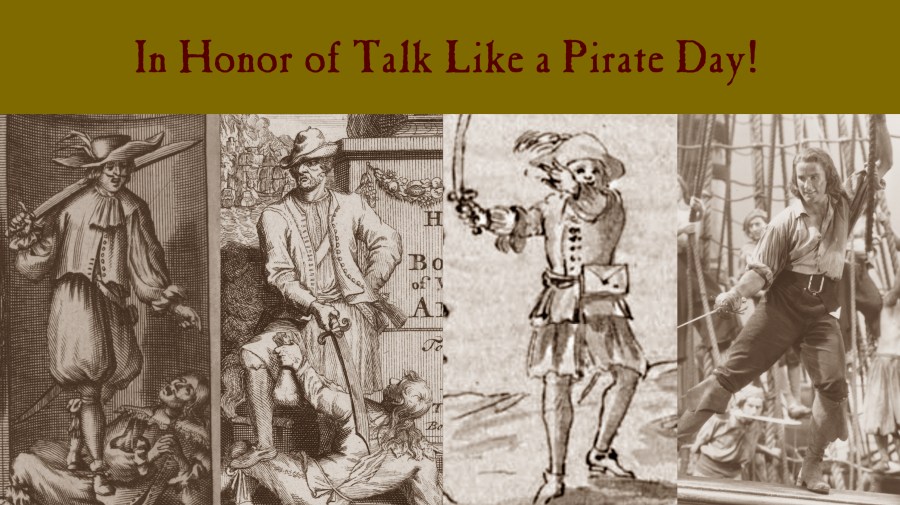
The probably French buccaneer on the far left in the illustration above is a detail from De Americaensche Zee-Roovers by A. O. Exquemelin, 1678, in the Library of Congress; the probably Dutch buccaneer at left center is a detail from Historie der Boecaniers, of Vrybuyters van America by Alexandre Exquemelin, 1700; the French buccaneer at right center is an eyewitness illustration, that is, what one truly looked like, a detail from a chart of Petit Goave drafted in 1688 by Paul Cornuau, Archives Nationale d’Outre-Mer; and on the far right is Errol Flynn in a detail from a publicity still for Captain Blood, Warner Bros. 1935.

Copyright Benerson Little 2024. First published September 19, 2024.

The Annotated Captain Blood: An Update

A quick update on our first publishing project here at Treasure Light Press. The annotations for Captain Blood: His Odyssey by Rafael Sabatini are roughly 90% complete. We’re looking at a hardcover edition with approximately 300 illustrations, and annotations and appendices with a word count greater than the novel itself. It’s been a fun project. More news to follow over the next year as the manuscript goes to editing and actual production begins.

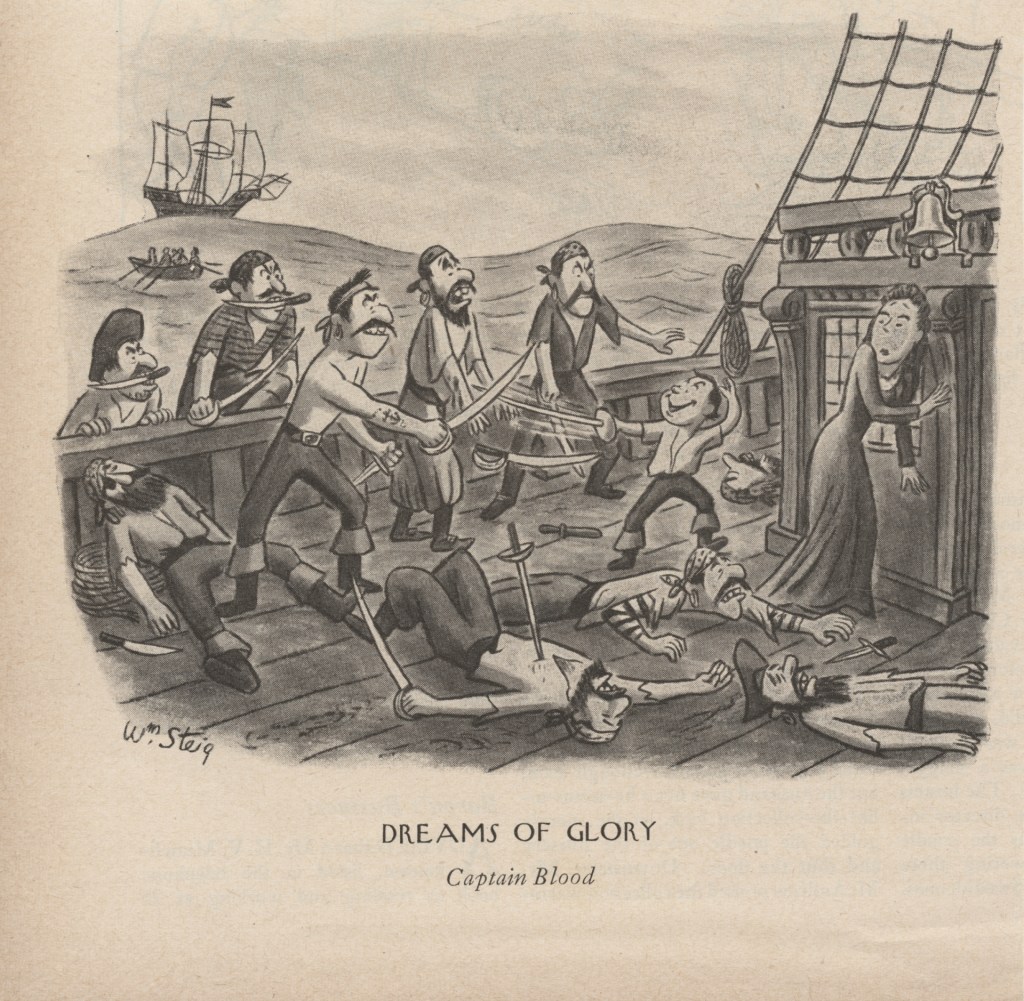
“Dreams of Glory” — Captain Blood! (Updated!)

Comic by William Steig, The New Yorker, August 30, 1952.

I’ve seen myself in comics before — Calvin & Hobbes, Bloom County, Peanuts, Shoe, Hagar the Horrible, Popeye, and even in an imagined sense in Buz Sawyer, Prince Valiant, and The Phantom — but never so closely as in the image above. This is my dream of glory as a child! And likewise many friends and acquaintances of mine, particularly those who’ve lived lives of real or armchair swashbuckling from childhood onward.

The comic was drawn by William Steig, best-known today for Shrek. However, he drew a series of “Dreams of Glory” comics in the 1940s and 50s (I hope I have the dates correct) for various upscale magazines, primarily The New Yorker. Most if not all of the comics were published in a single volume in 1953.

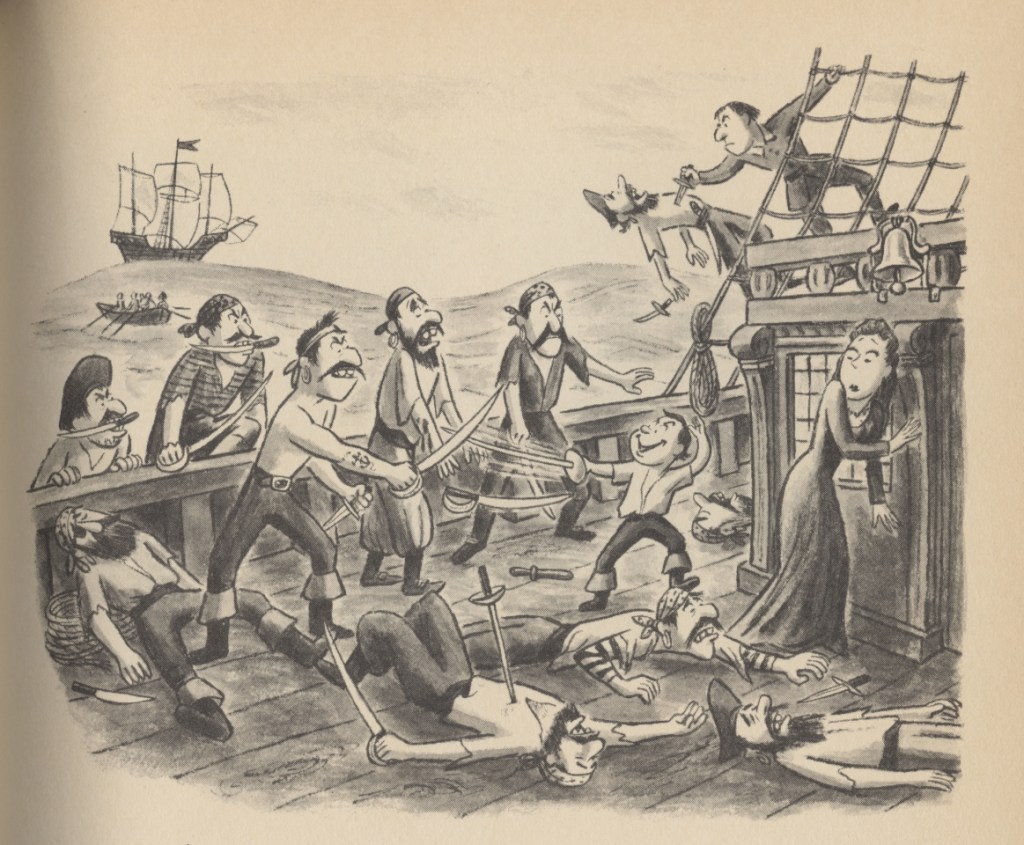
I’ve updated this post due to my examination of the 1953 volume, entitled Dreams of Glory. I discovered that the original comic, shown below, included two figures in the shrouds: a defender stabbing an attacking pirate in the heart. For the life of me I can’t understand why this was removed for publication in a magazine, not when there are already dead pirates everywhere on the deck, clearly dispatched by a child in his daydreams, not in reality.

This is akin to a Disney Pirates of the Caribbean book my kids and I love, a reiteration of the attraction and its song: it shows pirates attacking and plundering and water torturing, guns (cannon!) firing, a Spanish town in flames — but there are no firearms anywhere. They’ve been replaced by slingshots &c.

I understand the de-emphasis on firearms given the horrific rise in school shootings in the US, but I’m not sure that replacing firearms with slingshots, or deleting an actual act of violence while leaving the immediate effects of violence lying all around as in the comic above and below, is anything more than mere window dressing or facade that doesn’t alter the substance at all, much less provide a solution. It’s much easier to alter an illustration than to reasonably limit access to firearms and the evil corners of the Internet, not to mention delve into the development of other possible parts of the solution.

“Captain Blood” as published in 1953 in Dreams of Glory by William Steig. The artist’s preface is worth reading too!

Text copyright Benerson Little 2022. First posted October 12, 2022. Deleted and re-posted October 19, 2022 (unable to reblog, thus…).

“Captain Blood” on Halloween!

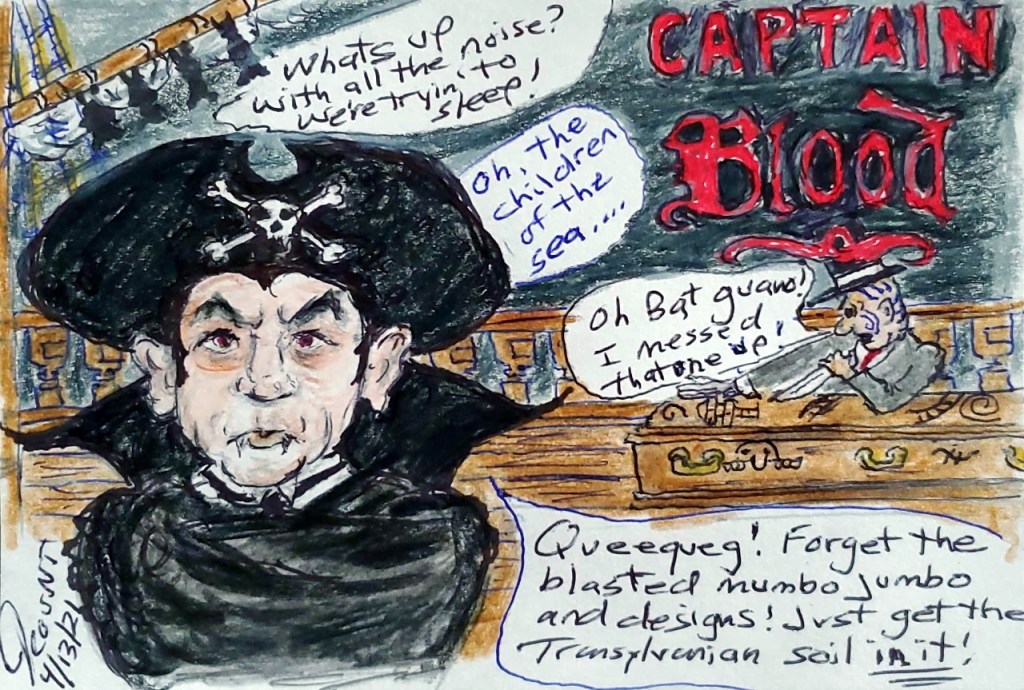
“Captain Blood” by Jim McDougall, 13 April 2021. Courtesy of and copyright by Jim McDougall.

A vampire — surely Lugosi himself! — riff on Captain Blood, with a Moby Dick reference no less, by friend and arms historian Jim McDougall. 🙂

Is the ship the Arabella, the Pequod, the Demeter, or the Vesta? 🙂

Comic copyright by Jim McDougall, 2021-2022. Blog copyright Benerson Little 2022. First posted October 17, 2021.

Captain Blood, Not Jack Sparrow: The Real Origin of Disney’s Wicked Wench Pirate Ship

Benerson Little's avatarSwordplay & Swashbucklers

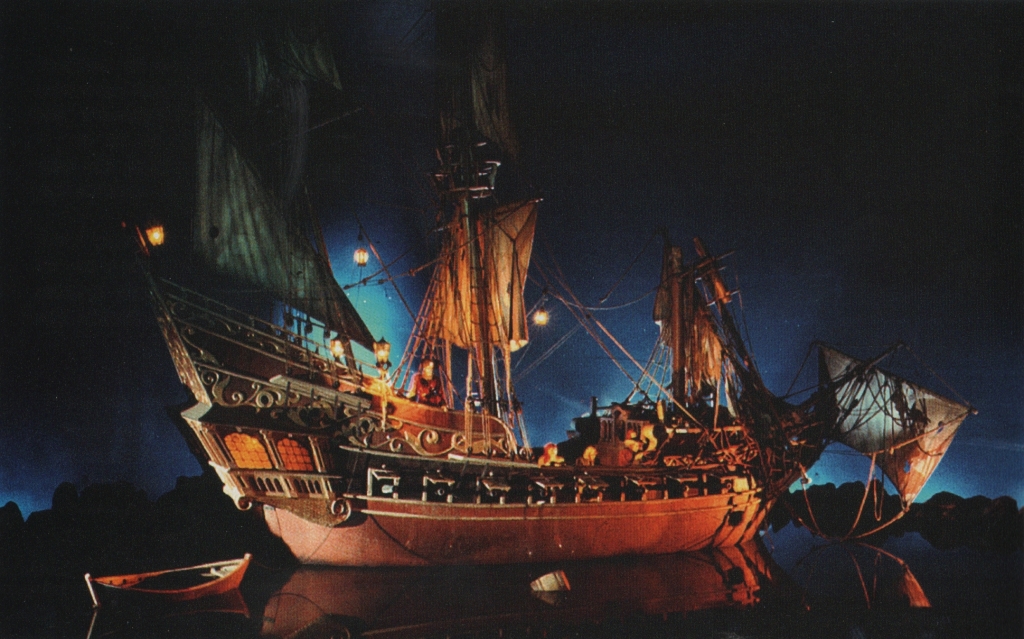
The Wicked Wench engaging the Spanish fort at Isla Tesoro. Disney publicity still.

It’s an epic image, one that anyone who’s ever cruised through the Pirates of the Caribbean attraction at one of the Disney theme parks is familiar with: a pirate ship cannonading — “firing its guns at” in sea parlance — a Spanish fort.

But the image-in-motion long predates the Disney attraction. In fact, as I’ll demonstrate shortly, the entire scene was lifted directly from Rafael Sabatini’s famous novel, Captain Blood: His Odyssey and especially from the 1935 film version starring Errol Flynn, Olivia de Havilland, and Basil Rathbone. And the Wicked Wench pirate ship of the attraction was more than simply inspired by the Cinco Llagas / Arabella, as the ship in the novel and film was named: it was copied from it!

Originally the attraction depicted buccaneers in the second half of the 17th century…

View original post 1,363 more words

James Speke Collection Update!

A few random items from the collection, including the volume of Horace and the silver-hilted smallsword discussed below.

Last year, after a long journey of intellectual curiosity, investigation with a near-gothic atmosphere, and more than one skullduggerous attempt to thwart us, we announced the acquisition of the James Speke of Comerton Collection of papers related to Caribbean piracy in the 1680s. The collection includes the original unpublished set of twenty-odd volumes of journals used by Rafael Sabatini as the factual basis for many of the adventures of his sanguinary hero, Captain Peter Blood.

We are continuing in the various processes of conservation, categorizing, copying, and transcribing the large number of documents ranging in date from 1685 to 1697, and which also include several boxes of books, such as several 17th to 19th century editions of Exquemelin’s Buccaneers of America, and a first edition of Macauley’s famous History. Oddly, the latter is the American edition rather than the expected UK edition.

Also included in the collection — which I hear through the grapevine our acquisition of which has incensed the board members of at least one UK museum and one US university, both having hoped to acquire it for themselves — is a pocket-size mid-17th century volume in quarter-calf of Horace’s Odes, Epodes, Satires, and Epistles in Latin, and a mid-1680s silver-hilted French smallsword with a colichemarde blade.

Based on several medical and nautical notations in pencil, including the style of hand, on the end papers of the volume of Horace, we believe it was once owned by a 17th century sea surgeon, or possibly a physician taking a sea voyage. The sword appears be the same one included with the book on a list of personal possessions. We cannot yet prove who they belonged to, yet we can also not restrain our hopeful imaginings!

For the moment we are continuing to limit access to the papers and journals to ourselves, aided by an experienced conservator (thanks, Shell!) of antiquarian books and papers. Again, per James Speke’s wishes more than a century ago, we intend to publish the collection of journals, the most important of them in hardcover, the remainder digitally.

We’ll keep you advised at least annually on our progress with the collection. We look forward not only to further discoveries in the history of buccaneering, but also to learning how they shaped Sabatini’s famous novel, Captain Blood: His Odyssey.

Copyright Treasure Light Press 2022. First posted April 1, 2022.

The Duel on the Beach, Part IV: Flynn versus Rathbone in Captain Blood!

Benerson Little's avatarSwordplay & Swashbucklers

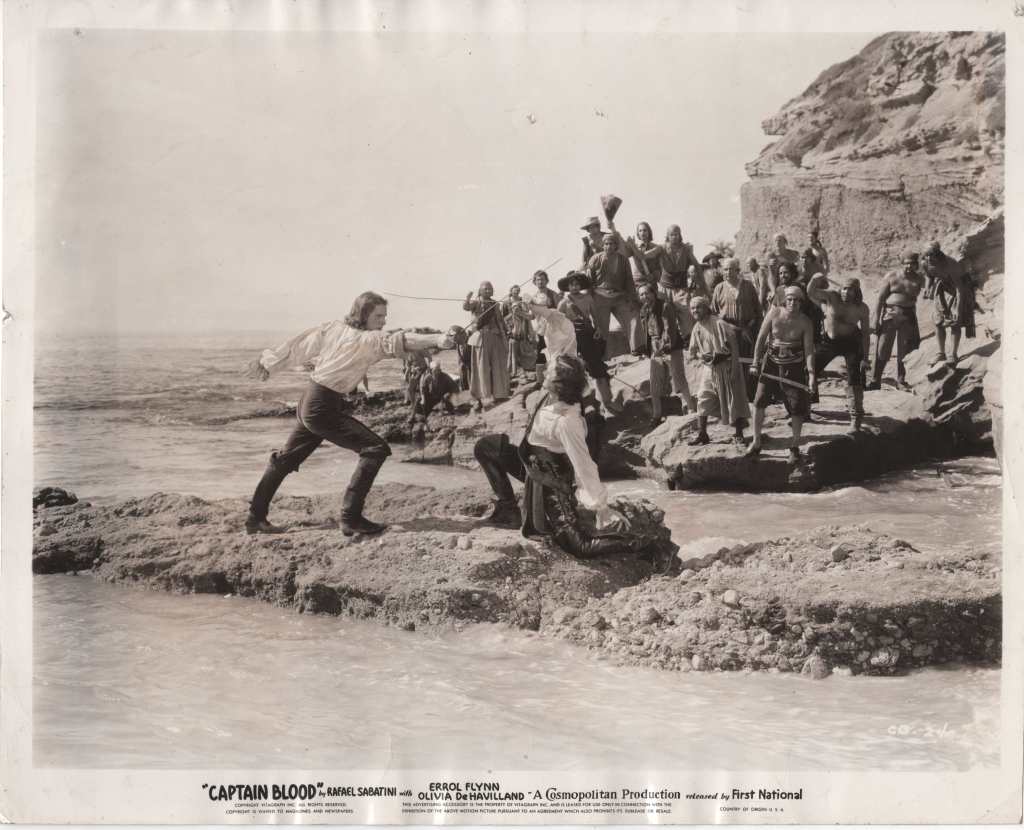
The duel on the beach in Captain Blood, clearly posed in reference and homage to the similar paintings of Howard Pyle and some of his former students. Original Warner Bros. publicity still, 1935. Author’s collection.

Classic film buffs, fencers, armchair adventurers, real swashbucklers, and romantics of many other stripes may debate over which film duel is the “best.” But no matter the standard, the duel between Errol Flynn as the hero Peter Blood and Basil Rathbone as the villain Levasseur in Captain Blood (1935) always makes the top few, often at number one. For me, there is no contest. There are a few far more historically accurate film duels (in fact, there are only a few historically accurate film duels at all), but none in my opinion exceed this one in sheer excitement, drama, swashbuckling swordplay, and watching pleasure.

The 1935 release, a remake of the silent 1924 film…

View original post 12,164 more words

How a Mystery Pirate Captain Gave Us Rafael Sabatini’s Captain Blood & the Films of Errol Flynn

Benerson Little's avatarSwordplay & Swashbucklers

Errol Flynn in a publicity still for Captain Blood, 1935, Warner Bros. Author’s collection.

With the advent of the 100th anniversary of the publication of Captain Blood: His Odyssey by Rafael Sabatini, not to mention our forthcoming thoroughly annotated anniversary edition, a look into the largely unknown, and until now unpublished, history behind the novel is timely: of real buccaneers and mystery pirates, of an incognito pirate captain whose identity we hope to reveal for the first time, and how without them there would be no famous novel Captain Blood nor any films of Errol Flynn, at least as we know them!

One of Sabatini’s major influences was the published journal of Monmouth rebel-convict Henry Pitman who, sentenced to indentured servitude on Barbados, escaped by sea, found himself marooned on Saltudos Island, and was eventually rescued by a crew of unnamed buccaneers. His story alone is worth the…

View original post 7,934 more words