In Honor of Talk Like a Pirate Day!

In honor of Talk Like a Pirate Day, some original, literary, and Hollywood buccaneer language of captains exhorting their crews!

“Yes, follow me and doe not lye behind, for if I doe amise* You will all fair the worse for itt.”

—Captain Richard Sawkins, English buccaneer captain, landing himself first and leading the attack against the “stokadoes” on the río Puebla Nueva (in the modern district of Remedios, Panama) in 1680, as quoted by buccaneer “E. P.,” probably Edward Povey. Sawkins “went up corragiously with some brisk men with him, butt their was provided Mollattas and hunters with their launces which came to oppose him. He fierd his Pistole and shott downe one Musteese, the rest fiering and lodeing as fast as they could, but the Spaniards coming in upon them so fast that kill’d capt. Sawkins and 3 men more.” The buccaneers were forced to take to their heels.   * Probably amiss: to go amiss, to fail.

“Have a good courage. We must either defend ourselves like good soldiers, or lose our lives with all the riches we have gotten. Do as I shall do, who am your Captain. At other times we have fought with fewer men than we have in our company at present, and yet we have overcome greater numbers than there possibly can be in this town. The more they are, the more glory we shall attribute unto our fortune, and the greater riches we shall increase unto it.”

—Captain François L’Ollonois, aka Jean David Nau, prior to the attack on Gibraltar on Lake Maracaibo in 1666, as quoted by Alexandre Exquemelin, buccaneer-surgeon and buccaneer chronicler who likely sailed under him, from the 1684 English edition (Crooke) of The Buccaneers of America. The speech, while it might be authentic, might also be embellished, recreated and revised from poor memory, or even apocryphal, added after the fact for editorial emphasis. L’Ollonois, a bloody-minded buccaneer and murderer, was killed by Native Americans on the Darien coast in 1669, burned, and his ashes reportedly scattered to the wind.

“You are too experienced to not understand the peril we are running, and too brave to fear it. It is necessary here to be cautious of all yet to risk all, to defend and attack at the same time. Valor, deception, fear, and even despair must all be put to use on this occasion; where, if we fall into the hands of our enemies, nothing awaits us but all sorts of infamies, from the most cruel of torments to, finally, the end of life. We must therefore escape their barbarity; and to escape, we must fight.”

—Captain Laurens de Graff, Dutch buccaneer in the service of French flibustiers, prior to his fight against the Capitana and Almirante of the Armada de Barlovento in 1685, each ship twice the size of de Graff’s Neptune and throwing twice its weight in iron, as quoted (and perhaps embellished, and clearly edited) by Alexandre Exquemelin in the French edition of The Buccaneers of America. De Graff was later wounded in the action, but ordered his men to carry him back on deck when he noticed his ship’s guns slacking their fire. The Spanish men-of-war took enough of a beating that they fled the scene overnight. (My translation.)

“On, now, Jeremy!” cried Blood. “Straight into them before they recover their wits. Stand by, there! Prepare to board! Hayton … the grapnels! And pass the word to the gunner in the prow to fire as fast as he can load. … Musketeers to the prow!”

—the fictional Captain Peter Blood in Captain Blood: His Odyssey by Rafael Sabatini (1922), during the finale against the French fleet at Port Royal, Jamaica, set in the year 1689.

“All right, my hearties, follow me!”

—Errol Flynn as the fictional Captain Peter Blood in Captain Blood (Warner Bros., 1935, Casey Robinson screenwriter) during the finale against the French fleet at Port Royal, Jamaica, from the gun’l, his ship sinking, just before he swings Hollywood-style from ship to ship, leading his men in a boarding action. The line is not in the published script, but apparently was written or adlibbed during filming. The original line was “Over we go, lads!” Flynn also uses much of Sabatini’s language above prior to boarding.

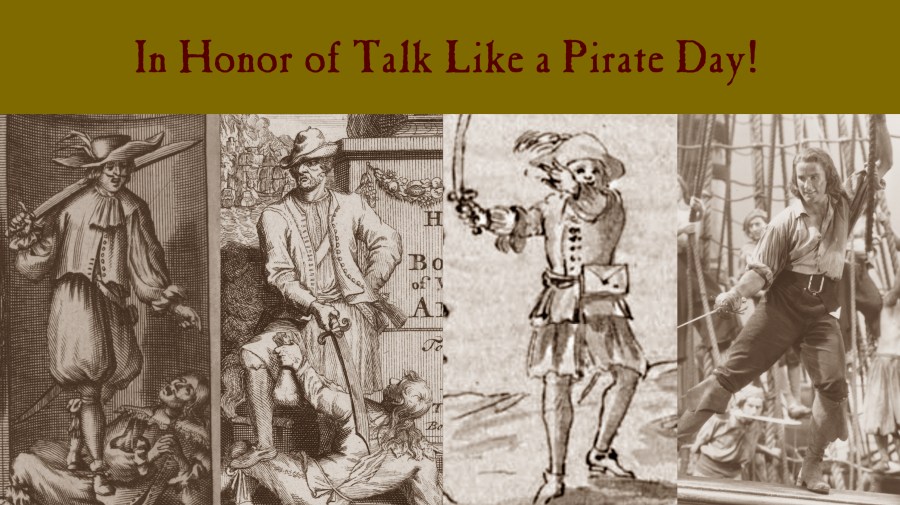
The probably French buccaneer on the far left in the illustration above is a detail from De Americaensche Zee-Roovers by A. O. Exquemelin, 1678, in the Library of Congress; the probably Dutch buccaneer at left center is a detail from Historie der Boecaniers, of Vrybuyters van America by Alexandre Exquemelin, 1700; the French buccaneer at right center is an eyewitness illustration, that is, what one truly looked like, a detail from a chart of Petit Goave drafted in 1688 by Paul Cornuau, Archives Nationale d’Outre-Mer; and on the far right is Errol Flynn in a detail from a publicity still for Captain Blood, Warner Bros. 1935.

Copyright Benerson Little 2024. First published September 19, 2024.

The Annotated Captain Blood: An Update

A quick update on our first publishing project here at Treasure Light Press. The annotations for Captain Blood: His Odyssey by Rafael Sabatini are roughly 90% complete. We’re looking at a hardcover edition with approximately 300 illustrations, and annotations and appendices with a word count greater than the novel itself. It’s been a fun project. More news to follow over the next year as the manuscript goes to editing and actual production begins.

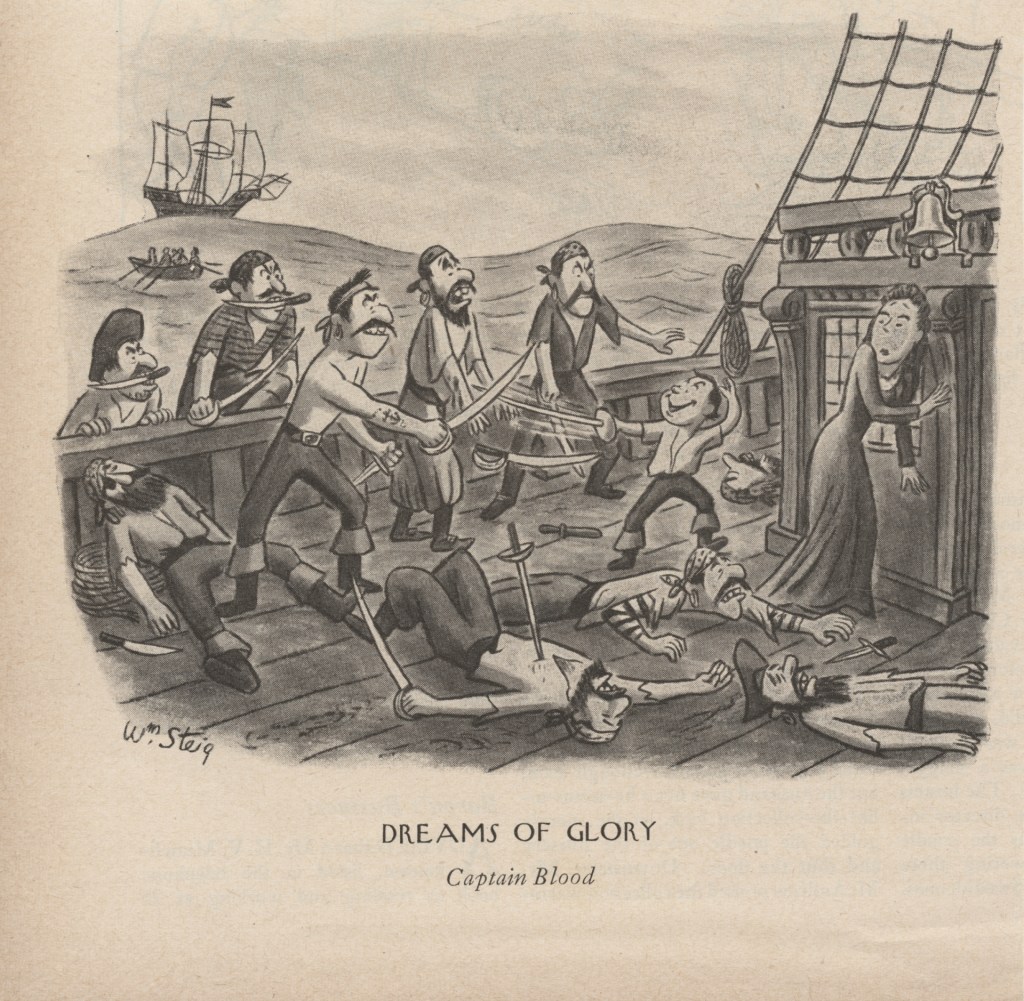
“Dreams of Glory” — Captain Blood! (Updated!)

Comic by William Steig, The New Yorker, August 30, 1952.

I’ve seen myself in comics before — Calvin & Hobbes, Bloom County, Peanuts, Shoe, Hagar the Horrible, Popeye, and even in an imagined sense in Buz Sawyer, Prince Valiant, and The Phantom — but never so closely as in the image above. This is my dream of glory as a child! And likewise many friends and acquaintances of mine, particularly those who’ve lived lives of real or armchair swashbuckling from childhood onward.

The comic was drawn by William Steig, best-known today for Shrek. However, he drew a series of “Dreams of Glory” comics in the 1940s and 50s (I hope I have the dates correct) for various upscale magazines, primarily The New Yorker. Most if not all of the comics were published in a single volume in 1953.

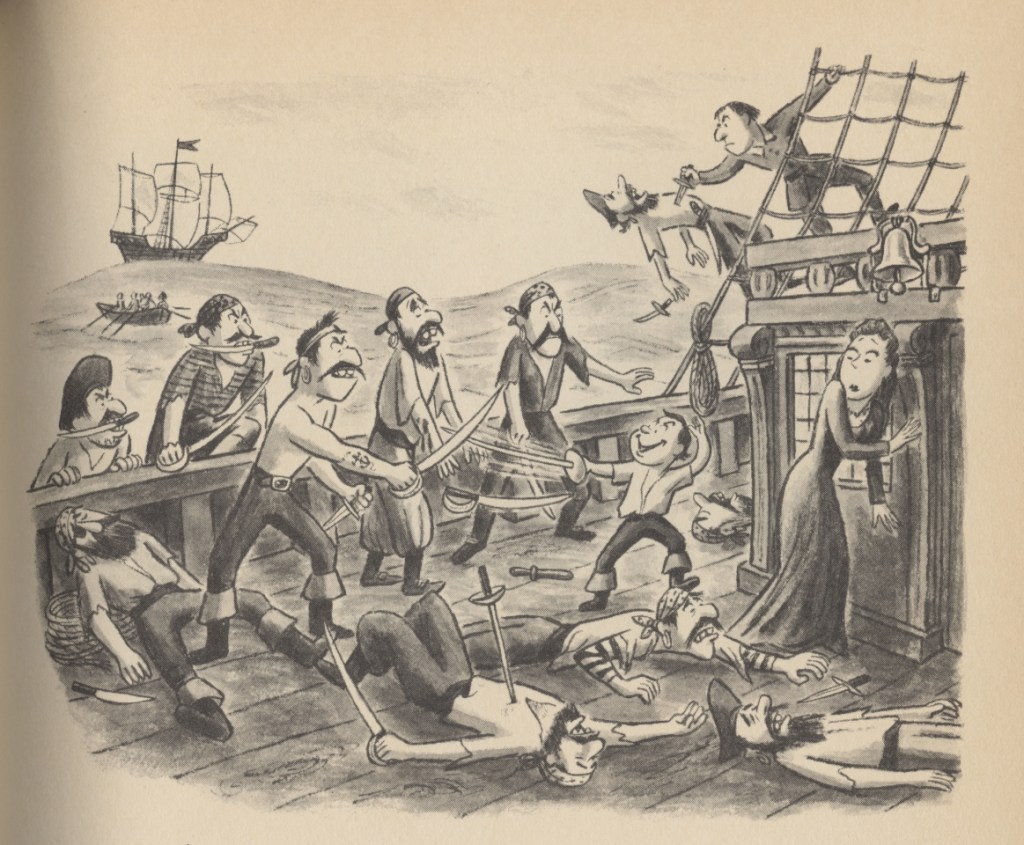
I’ve updated this post due to my examination of the 1953 volume, entitled Dreams of Glory. I discovered that the original comic, shown below, included two figures in the shrouds: a defender stabbing an attacking pirate in the heart. For the life of me I can’t understand why this was removed for publication in a magazine, not when there are already dead pirates everywhere on the deck, clearly dispatched by a child in his daydreams, not in reality.

This is akin to a Disney Pirates of the Caribbean book my kids and I love, a reiteration of the attraction and its song: it shows pirates attacking and plundering and water torturing, guns (cannon!) firing, a Spanish town in flames — but there are no firearms anywhere. They’ve been replaced by slingshots &c.

I understand the de-emphasis on firearms given the horrific rise in school shootings in the US, but I’m not sure that replacing firearms with slingshots, or deleting an actual act of violence while leaving the immediate effects of violence lying all around as in the comic above and below, is anything more than mere window dressing or facade that doesn’t alter the substance at all, much less provide a solution. It’s much easier to alter an illustration than to reasonably limit access to firearms and the evil corners of the Internet, not to mention delve into the development of other possible parts of the solution.

“Captain Blood” as published in 1953 in Dreams of Glory by William Steig. The artist’s preface is worth reading too!

Text copyright Benerson Little 2022. First posted October 12, 2022. Deleted and re-posted October 19, 2022 (unable to reblog, thus…).

“Captain Blood” on Halloween!

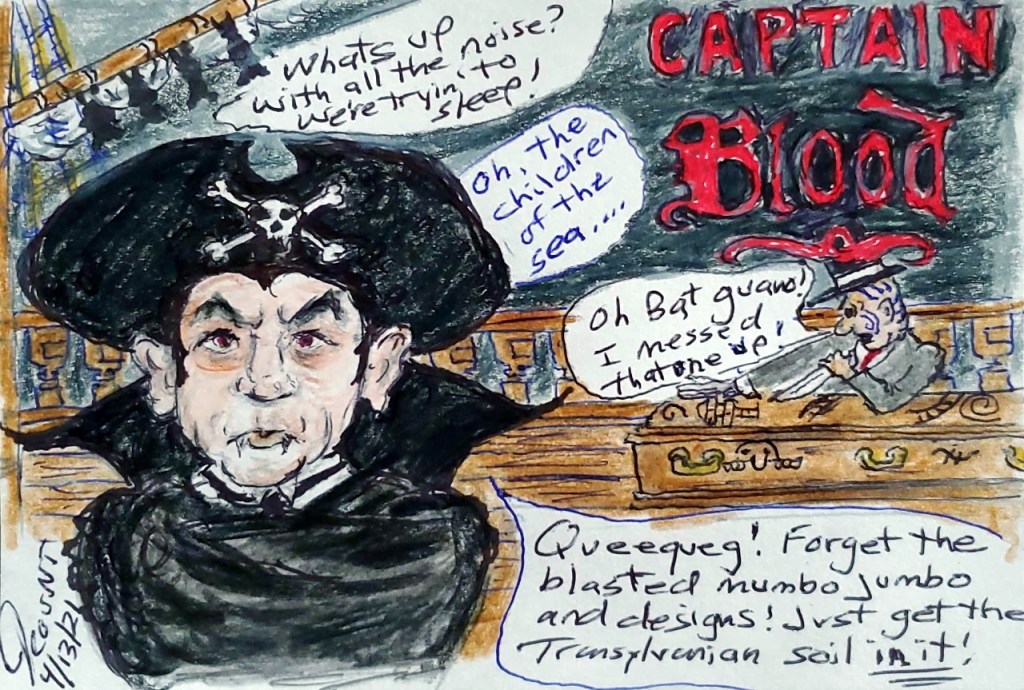
“Captain Blood” by Jim McDougall, 13 April 2021. Courtesy of and copyright by Jim McDougall.

A vampire — surely Lugosi himself! — riff on Captain Blood, with a Moby Dick reference no less, by friend and arms historian Jim McDougall. 🙂

Is the ship the Arabella, the Pequod, the Demeter, or the Vesta? 🙂

Comic copyright by Jim McDougall, 2021-2022. Blog copyright Benerson Little 2022. First posted October 17, 2021.

James Speke Collection Update!

A few random items from the collection, including the volume of Horace and the silver-hilted smallsword discussed below.

Last year, after a long journey of intellectual curiosity, investigation with a near-gothic atmosphere, and more than one skullduggerous attempt to thwart us, we announced the acquisition of the James Speke of Comerton Collection of papers related to Caribbean piracy in the 1680s. The collection includes the original unpublished set of twenty-odd volumes of journals used by Rafael Sabatini as the factual basis for many of the adventures of his sanguinary hero, Captain Peter Blood.

We are continuing in the various processes of conservation, categorizing, copying, and transcribing the large number of documents ranging in date from 1685 to 1697, and which also include several boxes of books, such as several 17th to 19th century editions of Exquemelin’s Buccaneers of America, and a first edition of Macauley’s famous History. Oddly, the latter is the American edition rather than the expected UK edition.

Also included in the collection — which I hear through the grapevine our acquisition of which has incensed the board members of at least one UK museum and one US university, both having hoped to acquire it for themselves — is a pocket-size mid-17th century volume in quarter-calf of Horace’s Odes, Epodes, Satires, and Epistles in Latin, and a mid-1680s silver-hilted French smallsword with a colichemarde blade.

Based on several medical and nautical notations in pencil, including the style of hand, on the end papers of the volume of Horace, we believe it was once owned by a 17th century sea surgeon, or possibly a physician taking a sea voyage. The sword appears be the same one included with the book on a list of personal possessions. We cannot yet prove who they belonged to, yet we can also not restrain our hopeful imaginings!

For the moment we are continuing to limit access to the papers and journals to ourselves, aided by an experienced conservator (thanks, Shell!) of antiquarian books and papers. Again, per James Speke’s wishes more than a century ago, we intend to publish the collection of journals, the most important of them in hardcover, the remainder digitally.

We’ll keep you advised at least annually on our progress with the collection. We look forward not only to further discoveries in the history of buccaneering, but also to learning how they shaped Sabatini’s famous novel, Captain Blood: His Odyssey.

Copyright Treasure Light Press 2022. First posted April 1, 2022.

The Speke Papers Have Arrived!

“Zeeslag,” anonymous, after Reinier Nooms, 1650-1738. Rijksmuseum.

It is with great pleasure that Treasure Light Press announces the acquisition of the James Speke Collection of historical documents associated with Caribbean piracy during the 1680s. The collection includes the original unpublished set of twenty-odd volumes of journals used by Rafael Sabatini as the factual basis for many of the adventures of his sanguinary hero, Captain Peter Blood.

Author Benerson Little, co-publisher and annotator at Treasure Light Press, has been searching for the papers, long thought lost, for more than a quarter century. Their rediscovery was the result of a combination of diligent research, serendipity, and thankfully thwarted skullduggery, including attempted forgeries and book-breaking, all of which was an adventure in itself.

The collection, long held by James Speke of Comerton, UK, disappeared after the amateur scholar’s death and passed, often unknowingly, through several hands, eventually ending up in an attic in a house in uptown New Orleans just off St. Charles Avenue, not far from the Columns Hotel.

For the moment we are limiting access to the papers and journals to ourselves, aided by an experienced conservator (thanks, Shell!) of antiquarian books and papers. At some point, however, given their obvious historical value, we may lend or donate the papers to a research institution for access by scholars, Sabatini fans, and the public at large, with emphasis on serious amateur historians who lack university credentials or access. Having been snubbed at times by some academic institutions ourselves, we’re sympathetic to the plight of amateur scholars producing quality research.

More importantly, per James Comerton’s wishes more than a century ago, we intend to publish the collection of journals, the most important of them in hardcover, the remainder digitally.

We’ll keep you advised on our progress with the collection. We look forward not only to further discoveries in the history of buccaneering, but also to learning how they shaped Sabatini’s famous novel, Captain Blood: His Odyssey.

Copyright Treasure Light Press LLC 2021. First posted April 1, 2021.

Captain Blood: His Odyssey and Its Mass Market Paperback Covers

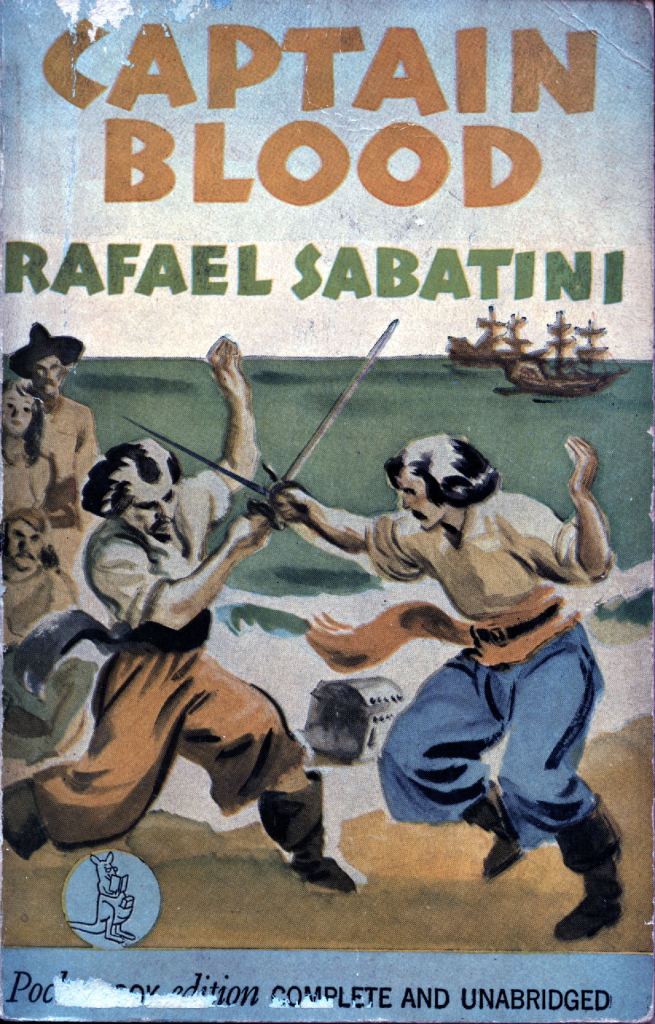
A brief chronology of mass market paperback covers from various publishers of Captain Blood: His Odyssey. The cover art ranges from mere pro forma to quite elaborate. Book cover art, including dust jackets, has one principal purpose beyond identifying the book and author: to entice readers into buying the book. Historical accuracy is secondary at best, and often entirely ignored–and sometimes even the actual text of the book itself is ignored, with tropes substituted instead. In any case, enjoy. 🙂

Pocket Books edition, UK, 1940, with color restored from a faded copy. The artwork is intended to represent the duel on the beach between Peter Blood and Levasseur.
Undated US Armed Forces edition printed during WWII by arrangement with Houghton Mifflin. The cover of the book depicted was never actually published except on the cover of this edition. A pirate with cutlass, a flag of skull and bones–this is all that’s necessary to lure the reader in.
Pocket Books edition, UK, fifth printing, 1943. The scene is not tied any specific one from the book, and was likely inspired by the dustjacket of Captain Blood Returns, see below. The sword hilt is entirely fanciful.
Cover art by Dean Cornwell for the dustjacket of Captain Blood Returns (1930). The same illustration in blue and white was used in “The Expiation of Madame Coulevain,” a 1930 magazine short story later published as part of Captain Blood Returns.
US Pyramid edition, 1961. Again, the cover is tied to no specific scene in the book, and includes anachronistic Hollywood Spaniards in morions, and the obligatory damsel in distress at the hero’s feet. The cover is intended to entice, not to accurately illustrate the novel.
UK Arrow edition, undated. 1950s or early 1960s? Sharp-eyed readers may note the black swan figurehead: the image was taken from a Hutchinson hardcover edition of Rafael Sabatini’s The Black Swan.
UK Pan edition, second printing 1963, original 1961. Again, the cover does not depict a scene from the book, but instead evokes its atmosphere. As in many Captain Blood illustrations, the protagonist has a mustache, unlike in the book (although he did have one in the original magazine series). The cutlass is both anachronistic and incorrect for Peter Blood. Unusually, the Spanish ship on the left is flying the correct flag.
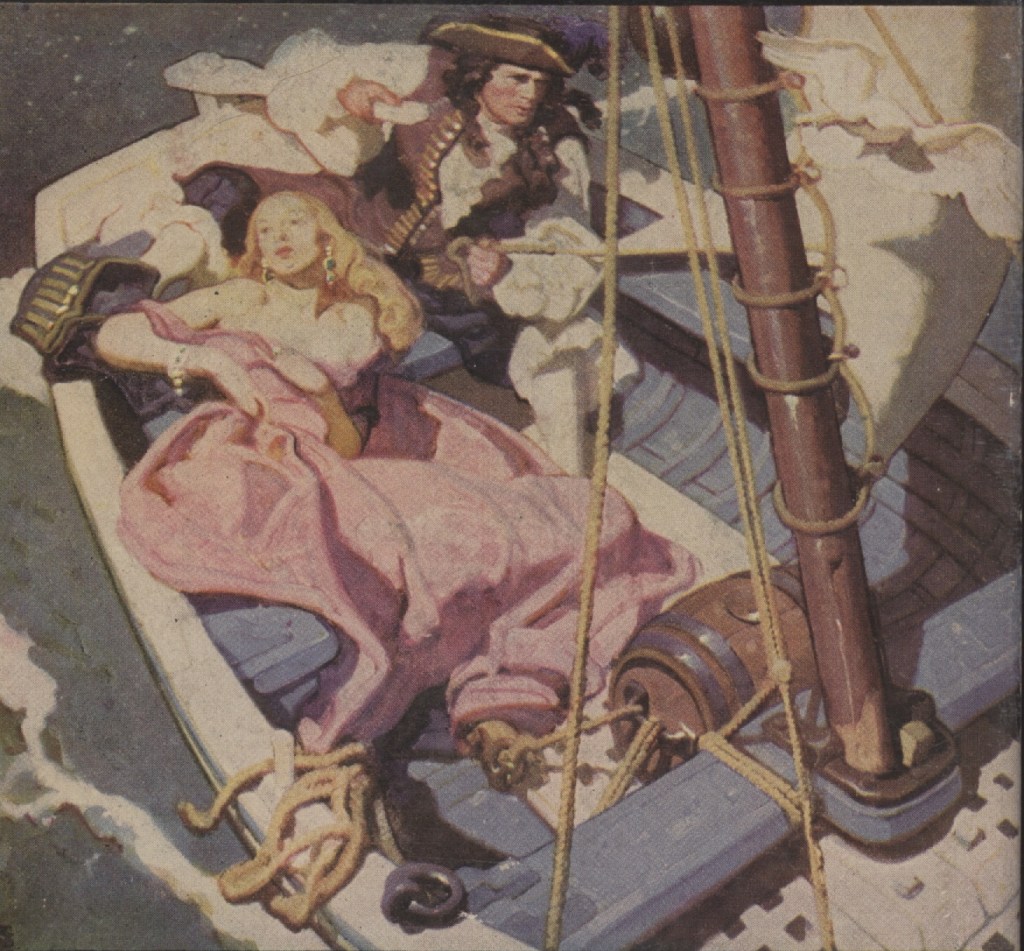
US Pyramid edition, third printing, 1967. This is the first edition I ever read, and its cover remains one of my favorites.
Publicity still for The Sea Hawk, 1940. The cover above was inspired by this photograph, and probably by publicity stills from Captain Blood and The Sea Hawk showing Errol Flynn on the gunwale during a boarding action.
UK Pan edition, 5th printing, 1974. Although the woman resembles Arabella Bishop, she is in fact, given the scene, the daughter of Governor d’Ogeron. And again, the mustache and, incorrectly (although common in Hollywood and fiction illustrations), riding boots.
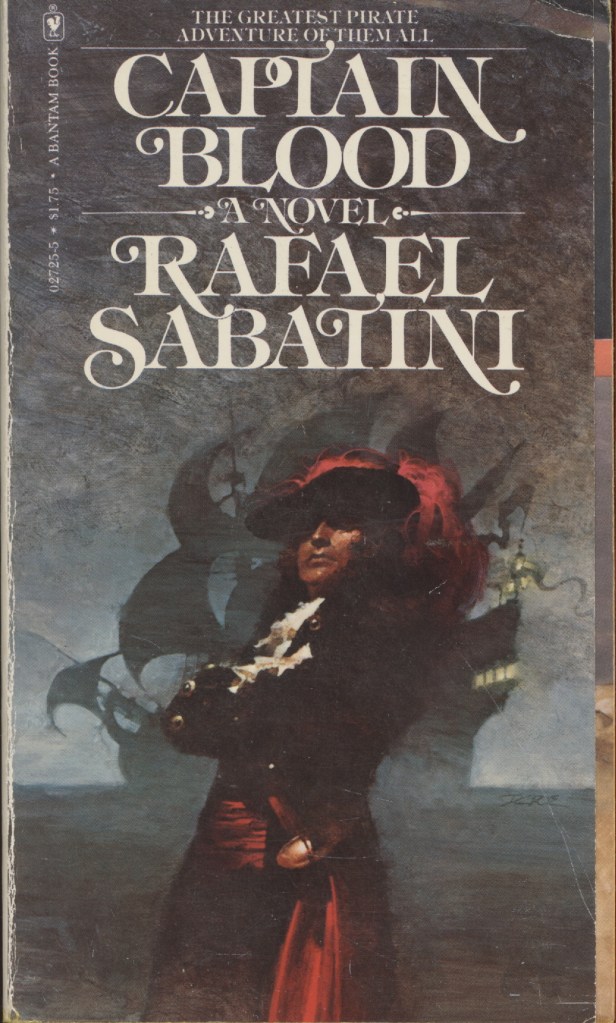
Without doubt the most elaborate and artistic of mass market Captain Blood covers. US Bantam edition, 1976, one of my favorites. See the image below.
Inside cover art, highly unusual in mass market paperbacks but occasionally found in trade paperbacks.
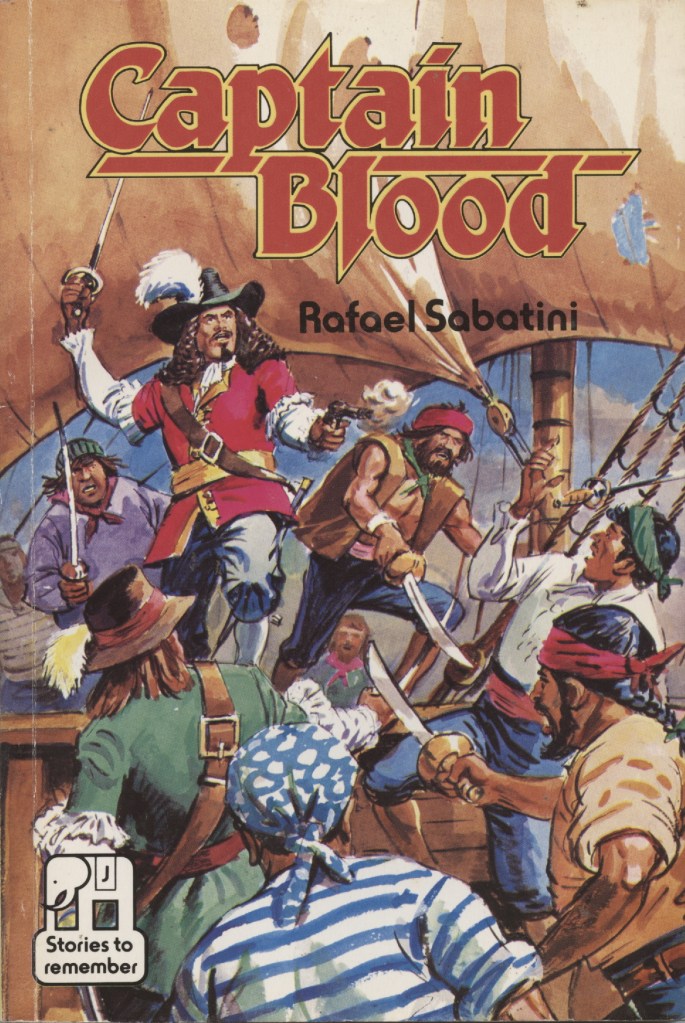
Much-abridged and simplified edition by E. F. Dodd for middle school / junior high school readers, published by Macmillan originally in 1964. This is the 1991 printing. These “Stories to Remember” editions were intended to make novels accessible to ESL readers and as to provide an easy introduction to novels for native speakers. I’m of two minds regarding such abridgements: on the one hand, they may encourage readers to try the full-length novels they might not otherwise attempt. On the other hand, I first read Captain Blood at 12 or 13, and I’ve a natural aversion to abridgement in any form, considering it destructive to the author’s work.

Most editions after the 1970s are larger trade paperbacks lacking original cover art. Publishers try to spend as little money as possible, often leaving cover art either simple or taken directly from artworks in the public domain. Howard Pyle’s pirate art is a common source for Captain Blood editions, and for the cover art of many books on the subject of piracy as well (including one of my own, The Buccaneer’s Realm).

Copyright Treasure Light Press LLC, 2021. First posted March 4, 2021. Last Updated October 9, 2022. Text by Benerson Little.

Apropos

“Excalibur and Taunton Castle Gate” by Ken Grainger, 2009. At Taunton Castle was Dr. Peter Blood tried and convicted of treason.

“Perhaps there ought to be a chapter about the coronation. The barons naturally kicked up a fuss, but, as the Wart was prepared to go on putting the sword into the stone and pulling it out again till Doomsday, and as there was nobody else who could do the thing at all, in the end they had to give in. A few of the Gaelic ones revolted, who were quelled later, but in the main the people of England and the partizans like Robin were glad to settle down. They were sick of the anarchy which had been their portion under Uther Pendragon: sick of overlords and feudal giants, of knights who did what they pleased, of racial discrimination, and of the rule of Might as Right.”

—T. H. White, The Once and Future King

Rebel-Convict Dr. Peter Blood Arrives at Barbados!

“The Emblem of the Shipp Cadiz Marchent that was in the yeare 1682. The Cadiz Merchant was likely similar to the Jamaica Merchant. From Edward Barlow’s manuscript of his seafaring career. Barlow made two voyages to Jamaica in the this ship, from 1680 to 1682. National Maritime Museum.

“Towards the middle of December the Jamaica Merchant dropped anchor in Carlisle Bay, and put ashore the forty-two surviving rebels-convict.” Rafael Sabatini in Captain Blood: His Odyssey.

The Jamaica Merchant was in fact a real ship home-ported in London. Commanded by Captain Charles Gardner, the ship took sixty-eight rebels-convict aboard, probably at Weymouth, and set sail in late October or early November 1685 for Barbados. Only one rebel-convict died en route. More died on other voyages, and the desperate conditions the rebels-convict were subjected to on the voyages were much as Sabatini describes them in his famous story.

Studio publicity still for Captain Blood (Warner Bros., 1935) suggesting the conditions aboard the Jamaica Merchant. In reality the space would be much more cramped and the ceiling would be much lower (probably five to five and a half feet). One period account describes conditions as appalling as those shown above.

In the novel, it’s implied that the rebels-convict are brought ashore immediately for sale, or more correctly, for the sale of the contracts for their sentences of indentured servitude for rebellion against their rightful king.

The reality was a little different. The rebels-convict were kept aboard for at least several days before being brought ashore, and it was not until March 12, 1686 before the Jamaica Merchant convicts were sold, in part to permit them to recover their health. Many after their contracts were sold were worked hard and abused, but most still had far better lives than African slaves did.

A rather fanciful representation of what is perhaps meant to be–and should be–a sugar mill. In reality in Barbados the wheel would be for pressing sugar cane and would be driven by a windmill, “water mill,” or a team of oxen (or occasionally mules). Further, nearly all of those doing the work would not be white servants, as shown here, but African slaves. Publicity still from Captain Blood (Warner Bros., 1935).
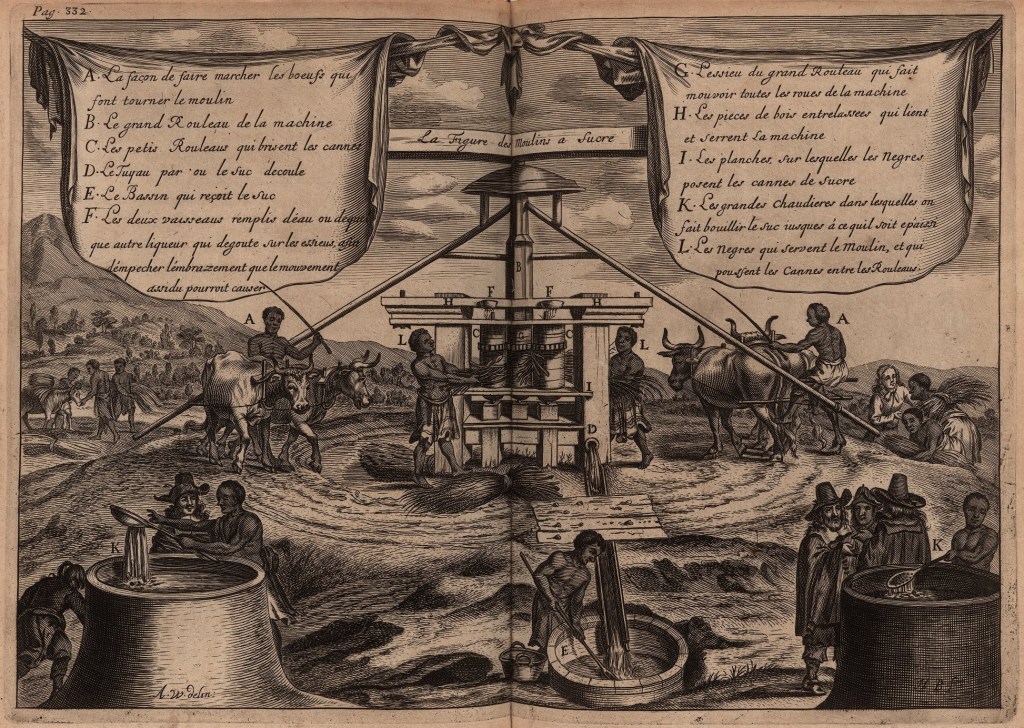
French sugar mill for pressing sugar cane. From Histoire naturelle et morale des iles Antilles de l’Amerique by Charles de Rochefort, 1665. John Carter Brown Library.

Although the term “slaves” is often used, and many rebels-convict were abused as if they were slaves, they were in fact indentured servants with a limit of ten years, not life, on their servitude, and they had many rights that slaves lacked. At bad as it might be, indentured servitude was by no means equivalent to the enormity of the enslavement of Africans or Native Americans in the Americas.

Copyright Treasure Light Press LLC. First posted December 20, 2020.

Olivia de Havilland’s Fencing Poses

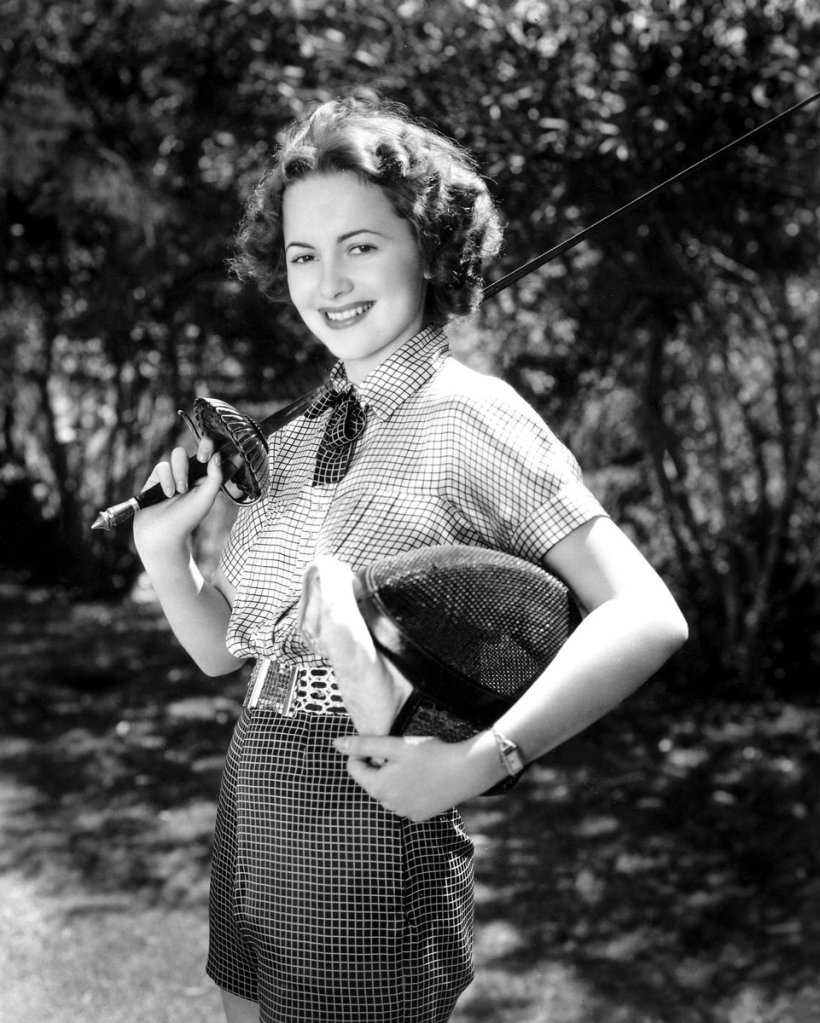
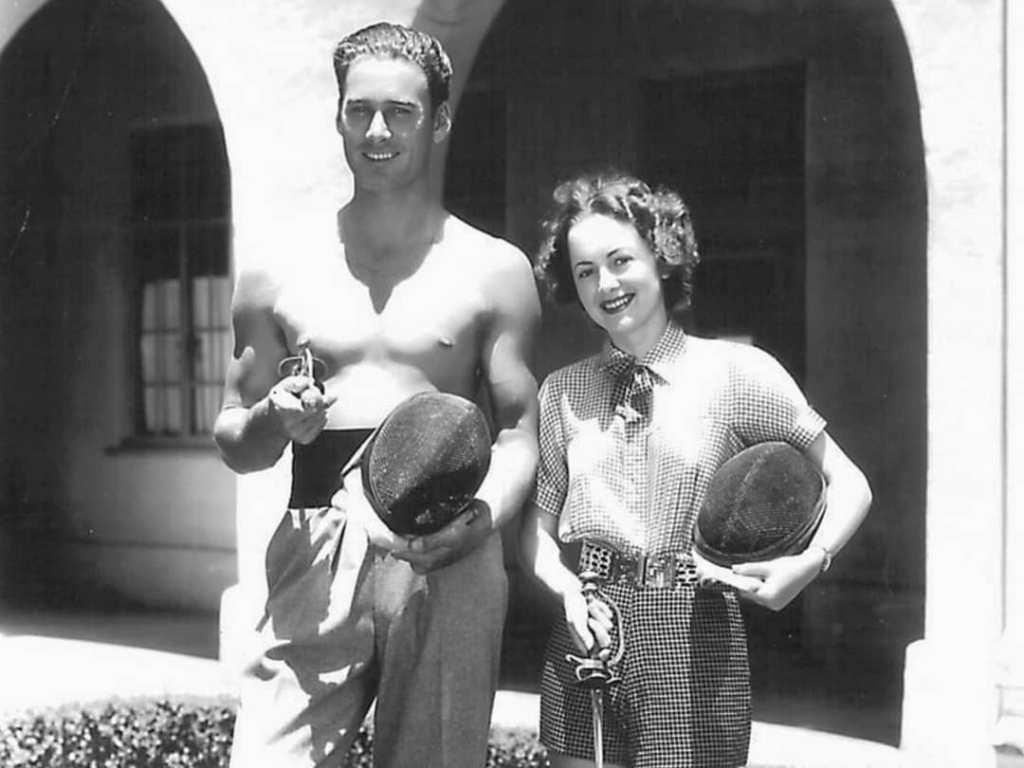
Olivia de Havilland, star of Captain Blood, The Adventures of Robin Hood, and numerous other films, posing with stage rapiers and smallswords, fencing masks, and star-to-be Errol Flynn in a series of Warner Bros. publicity stills for Captain Blood (1935). Most of these photographs were taken on the same day in July 1935 behind the Warner Bros. administrative building prior to the start of shooting. Ms. de Havilland passed away on July 26, 2020 at the age of 104.

Not a fencing pose per se, but a reading pose, Captain Blood by Rafael Sabatini, specifically, on the same day the photographs above were taken.
Likewise not a fencing post per se, but another publicity still for Captain Blood (1935). As a side note, the Collins machete she holds is almost certainly from the collection of Dwight Franklin, the historical consultant (and costume designer?) on the film. Franklin notes that such machetes were often carried by overseers and mounted police in Latin America at the time.

First posted September 21, 2020. Last updated December 23, 2023.