A very quick look at the trial of Dr. Peter Blood as depicted in two film versions.
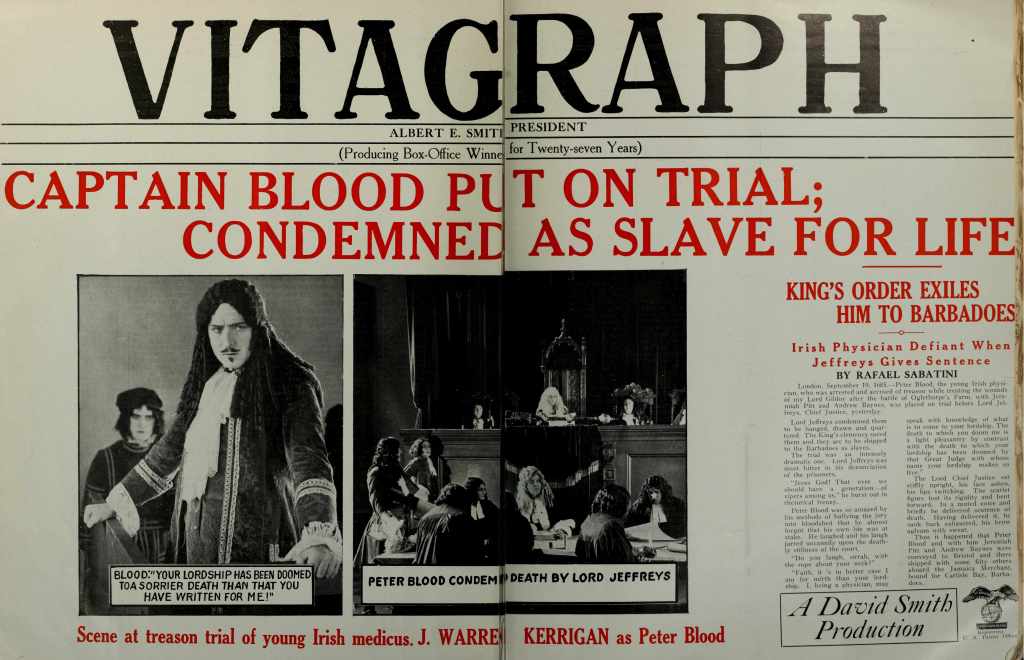
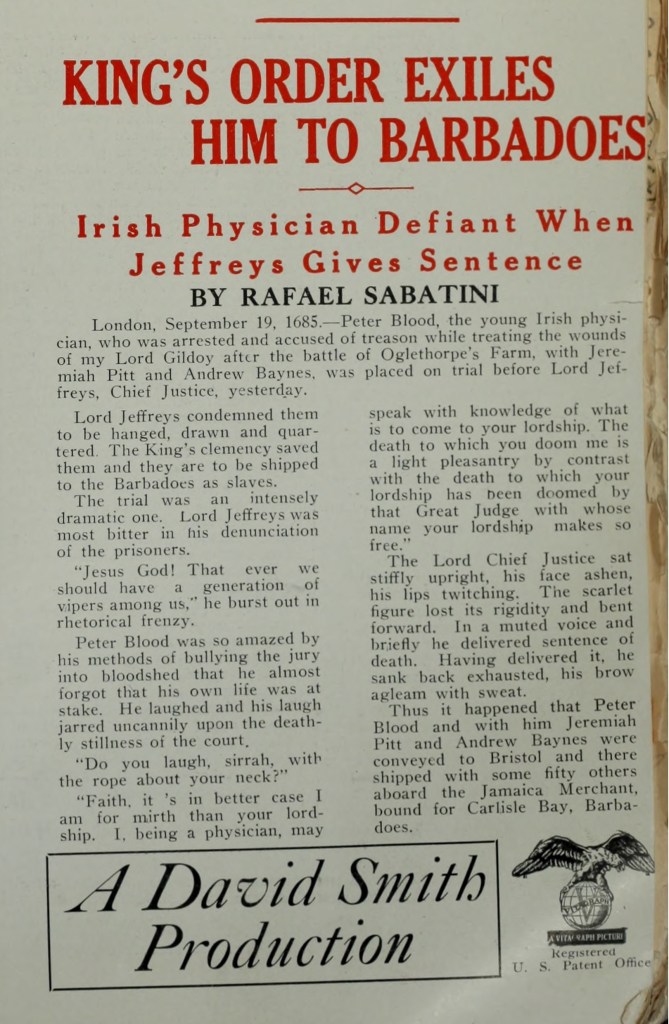
In support of the 1924 Captain Blood starring Walter Kerrigan, Vitagraph issued a series of advertisements in the form of newspaper headlines and articles, with text credited to author Rafael Sabatini:
Peter Blood is a bit too well-dressed in the scene, given his more than two months in a crowded jail. Sabatini’s original line is far more effective than the line in the film (see the image on the left above). From The Film Daily, Sunday August 31, 1924.Detail from the advertisement above.
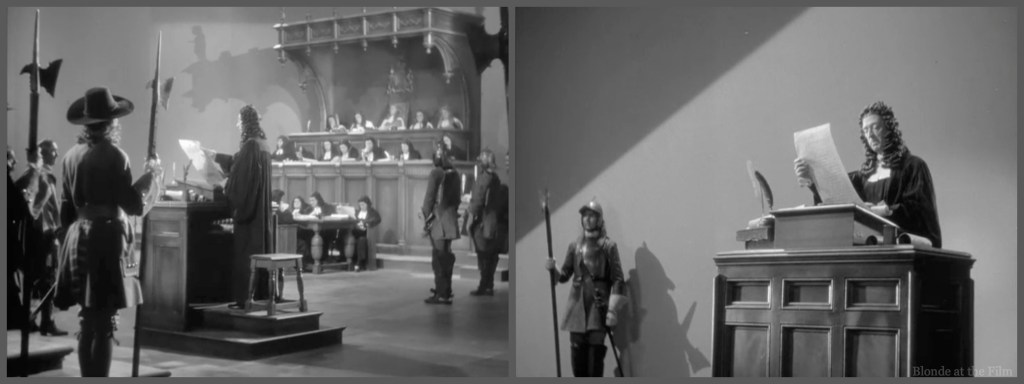
The sets in the 1935 Captain Blood were intended to be more figurative than entirely accurate, reflecting more the psychological impact of the trial. The sense of law-run-amok under the guise of patriarchal law and order is inescapable. The downside is that the set appears more theatrical than authentic.
The Bloody Assize courtroom in the Great Hall of Taunton Castle as depicted in the 1935 Captain Blood starring Errol Flynn. From the blog The Blonde at the Film.The prisoners at the bar; Dr. Blood looks as if he has indeed been jailed for more than two months. From the blog The Blonde at the Film.
Copyright Treasure Light Press LLC, 2020. First published September 20, 2020.
Taunton Castle as it appears today, much as it did in 1685. Wikimedia Commons: photograph by Simon Burchell.
The 19th of September: On this day in 1685, Old Style, fictional Dr. Peter Blood was tried and convicted of treason at Taunton Castle, in spite of his having done nothing more than obey the dictates of his conscience and his profession in treating a wounded rebel.
The trial was in fact quite real. From a draft end note to the forthcoming annotated Captain Blood: His Odyssey:
The 19th of September was the second day of the Taunton Assize in Somerset, the “chief seat of the rebellion.” Held in the Great Hall of Taunton Castle and presided over by Lord Chief Justice George Jeffreys, more than five hundred prisoners–514 to 534–were tried over two days. Four pleaded not guilty the first day; three of these men were sentenced to death but the fourth was set free. Approximately three hundred fifty more pleaded guilty the first day and were convicted. On the second day, many of the remainder pleaded guilty and were convicted. One hundred forty-six of those convicted at Taunton were sentenced to hang. Two were reprieved, but the rest were distributed among thirty-six nearby towns where they were hanged, dismembered, tarred, and their dismembered quarters hung from gibbets and various other convenient objects as a warning. Fifteen others sentenced to death were by accident left off Warrant for Execution. Two hundred eighty-four were condemned to transportation, and roughly seventy-seven were variously freed on bail, remitted to jail, recommended for mercy, or otherwise avoided the noose or transportation.
Peter Blood was one of the fortunate–or should we say, less unfortunate–ones, for he was, like the very real Henry Pitman who helped inspire his story, sentenced to be transported to Barbados for ten years in servitude.
Lord Chief Justice George Jeffreys attributed to William Wolfgang Claret, circa 1678 to 1680. Wikimedia Commons.
Copyright Treasure Light Press LLC. First published 19 September 2020.
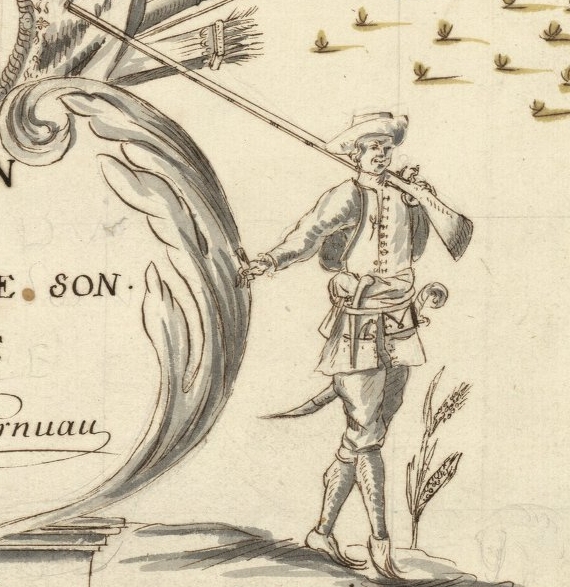
Flibustier (a French buccaneer) from a Chart of Le Cap on Saint-Domingue, 1686, by P. Cornuau. French National Library. Similar images can be found in my post here.
A brief post in honor of Talk Like a Pirate Day. 🙂
1. Active Duty Pirate Speech:
“[H]owever nothing daunted at the disadvantage of Fight, we made a resolution rather than drown in the Sea, or beg Quarter of the Spaniard, who we used to Conquer, to run the extreamest hazard of Fire and Sword, and after a sharp Contest, still birding with our Fusees as many as durst peep over Deck, we boarded one of them, and carried her; so with her we took the second; and the third had certainly run the same fate, had not she scoured away in time…”
–Buccaneer John Cox.
“Shee fierd a Harkquebus att us, att which wee presented them with a whole Volley; she fier severall small gunns at us, and wounded 3 men. one of them after-wards died. wee laid her aboard and tooke her. She had about 30 hands in her, fitted out for an Armadillo to come downe to the Isle of Plate, to see what a posture we lay in…”
–Buccaneer Edward Povey.
2. Retired Pirate Speech:
“In his drink Sir Henry [Morgan] reflects on the Government, swears, damns, and curses most extravagantly…”
–Calendar of State Papers, Colonial, America and West Indies.
“But fortunately romance never dies. The spiritual hunger of humanity seeks nourishment in ideals, which it is the business of romance to furnish. Romance is of no particular time or age. If it has usually preferred to lean upon the remote epochs, it is only because the remote is easier to idealise.”
–Rafael Sabatini, “My New Adventures of Captain Blood,” Pearson’s Magazine, December 1929.
“I hope no man will call me timorous; and yet I’ld as soon be called that as rash.”
Dr. Peter Blood, about to become Captain Blood, commenting on the dangers of blind faith in the face of contrary reality in Captain Blood Returns, “The Blank Shot,” by Rafael Sabatini, 1930.
In other words, wear your mask!
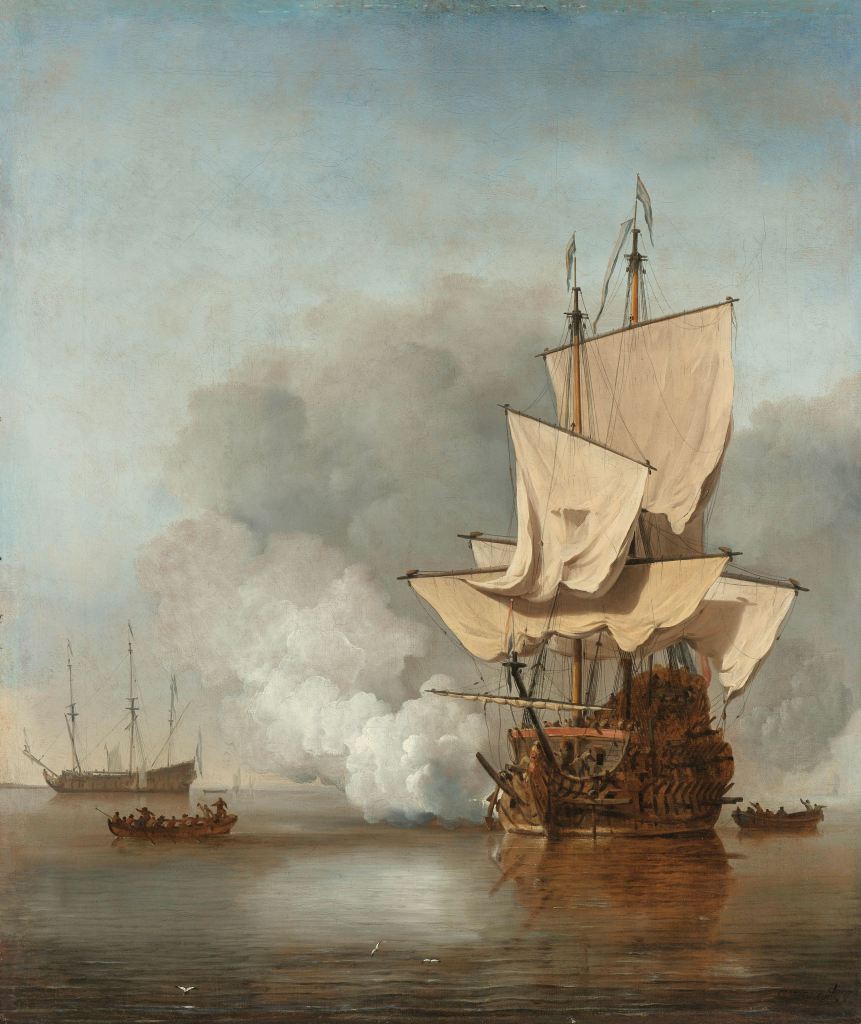
Het kanonschot (The Cannonshot) by Willem van de Velde the Younger, ca. 1680. Rijksmuseum.
Early in the morning on this day, July 6, 1685, Old Style, the rebel force of the Duke of Monmouth, pretender to the Crown, was defeated at Sedgemoor. Monmouth’s rebellion was brutally crushed.
Fictional physician (clearly one with surgical skill as well) Dr. Peter Blood, in spite of having taken no part in the rebellion, was arrested for treason for having treated the wounds of a rebel.
Also arrested for treason was sea chyrurgeon Henry Pitman of Yeovil, his family Quaker, whose account of his odyssey would go far to inspire Captain Blood: His Odyssey by Rafael Sabatini.
According to Pitman, he had come to see Monmouth and his army, then headed home with a friend but found himself caught between the rebel camp and Royalist patrols. He returned to Monmouth’s camp, lost his horse (probably confiscated by the rebels), and was prevailed upon by friends in Monmouth’s army to help treat the wounded.
Pitman claimed he was merely doing his Christian duty in treating the wounded, both rebels in arms and Royalist prisoners. Though never in arms, he was in Bridgwater during the Battle of Sedgemoor, possibly even with the army as it marched to attack, and was captured as he fled homeward after the defeat.
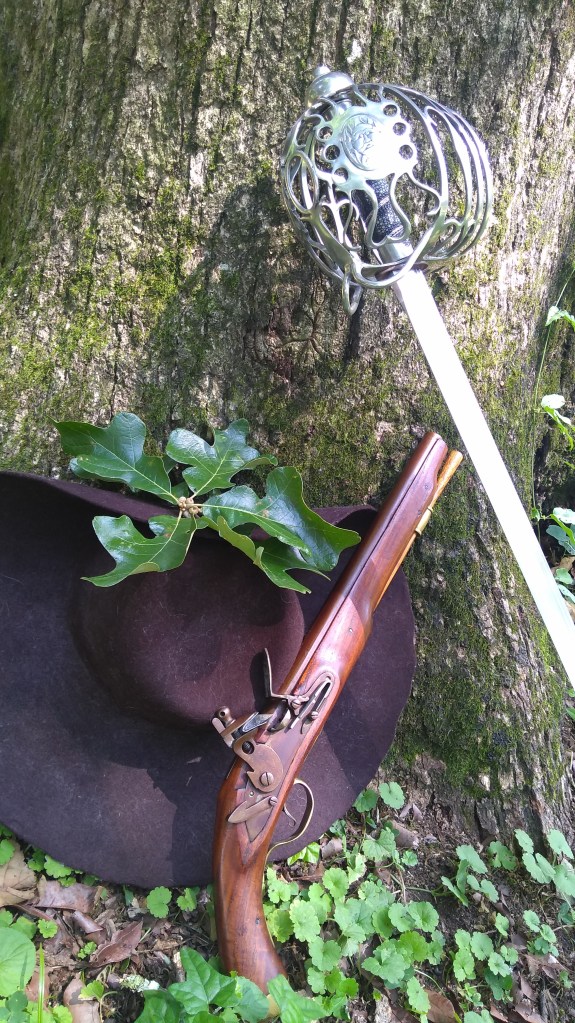
Oak leaves were a recognition device worn by many followers of the Duke of Monmouth. The pistol is a replica doglock common to the period. The hilt of the replica backsword is of a style made in both England and Scotland from the late 17th century into the 18th. Photograph by Mary E. Crouch.
July 5, 2020: On this date, July 5, 1685 (Old Style), as he smoked his pipe and tended his geraniums, the fictional and eponymous Dr. Peter Blood flung these words after the very real Monmouth volunteers flooding into Bridgwater on the eve of the Battle of Sedgemoor. Hours later the rebels met a brutal defeat, followed by brutal pursuit and prosecution as traitors.
Many of the Monmouth rebels-convict fortunate enough to avoid the noose were transported in servitude to Barbados. One of them, surgeon Henry Pitman, escaped and via his account of his adventures ultimately provided a significant part of the inspiration for Captain Blood: His Odyssey by Rafael Sabatini.
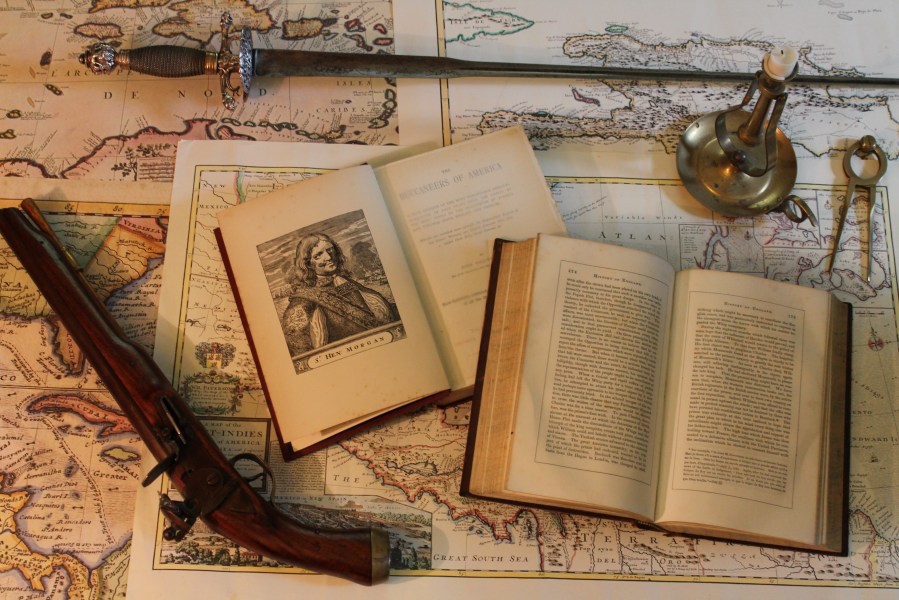
The now-famous Latin quote is the first line of Horace’s Epode VII. Addressed to the Roman people and inspired by the continued Roman civil wars, it asks “Whither, whither, are you wicked men rushing?” The open book in the image is a 1650 edition of the Carmina, Epodes, and Satires of Horace–perhaps even the same well-thumbed volume kept by Peter Blood. 🙂
For those of you with an eye for historical fact and detail, the modern Gregorian date, as opposed to the original old style or Julian date, for the 325th anniversary of July 5, 1685 is actually July 15, 2020.
We continue to press forward with our 100th Anniversary Annotated Edition of Captain Blood: His Odyssey!
June 30, 2020. To date, the only change we’ve made is to postpone the Kickstarter for the annotated anniversary edition of Captain Blood: His Odyssey until early 2021, for publication in late 2021 or early 2022 as originally planned. Annotations and illustration acquisition continue as planned, and we continue to work on marketing, including the development of videos.
We’re also looking at our second title (an equally or even more famous book), and if our budget permits, an annotated edition of Henry Pitman’s journal.
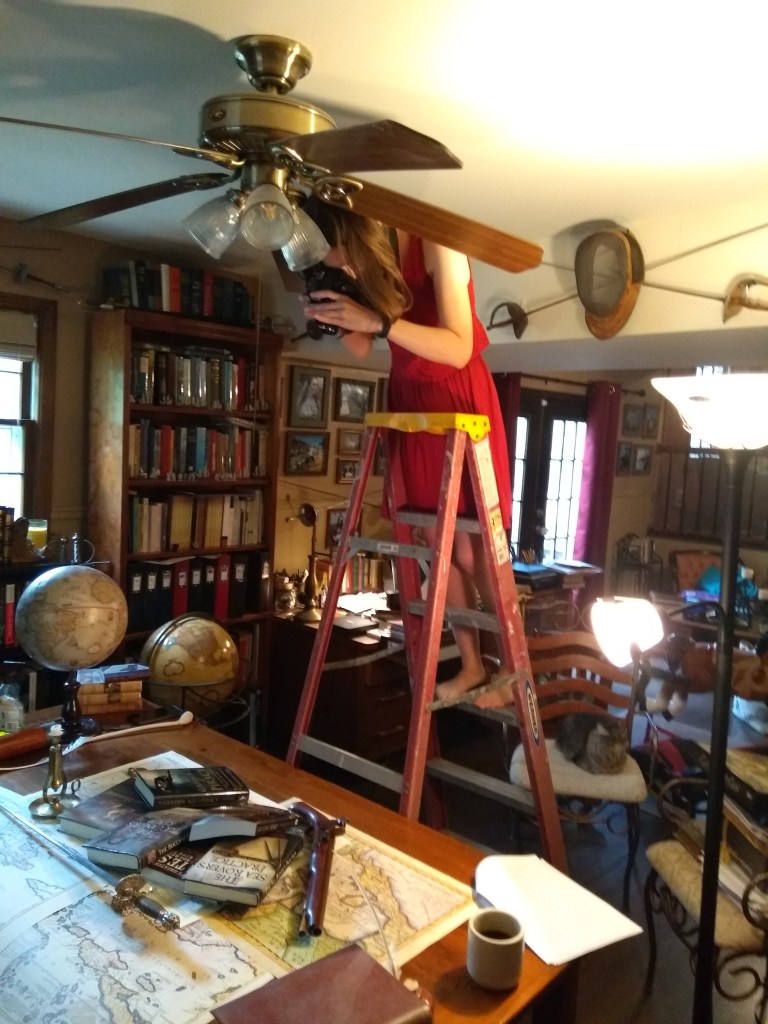
The images are of Marguerite (Bree) Little shooting still photographs for our first video. It’s always useful to have lots of antique and reproduction props at hand (not to mention a visiting daughter who’s also a great photographer).








 🙂
🙂
 Treasure Light Press