Sedgemoor

Early in the morning on this day, July 6, 1685, Old Style, the rebel force of the Duke of Monmouth, pretender to the Crown, was defeated at Sedgemoor. Monmouth’s rebellion was brutally crushed.

Fictional physician (clearly one with surgical skill as well) Dr. Peter Blood, in spite of having taken no part in the rebellion, was arrested for treason for having treated the wounds of a rebel.

Also arrested for treason was sea chyrurgeon Henry Pitman of Yeovil, his family Quaker, whose account of his odyssey would go far to inspire Captain Blood: His Odyssey by Rafael Sabatini.

According to Pitman, he had come to see Monmouth and his army, then headed home with a friend but found himself caught between the rebel camp and Royalist patrols. He returned to Monmouth’s camp, lost his horse (probably confiscated by the rebels), and was prevailed upon by friends in Monmouth’s army to help treat the wounded.

Pitman claimed he was merely doing his Christian duty in treating the wounded, both rebels in arms and Royalist prisoners. Though never in arms, he was in Bridgwater during the Battle of Sedgemoor, possibly even with the army as it marched to attack, and was captured as he fled homeward after the defeat.
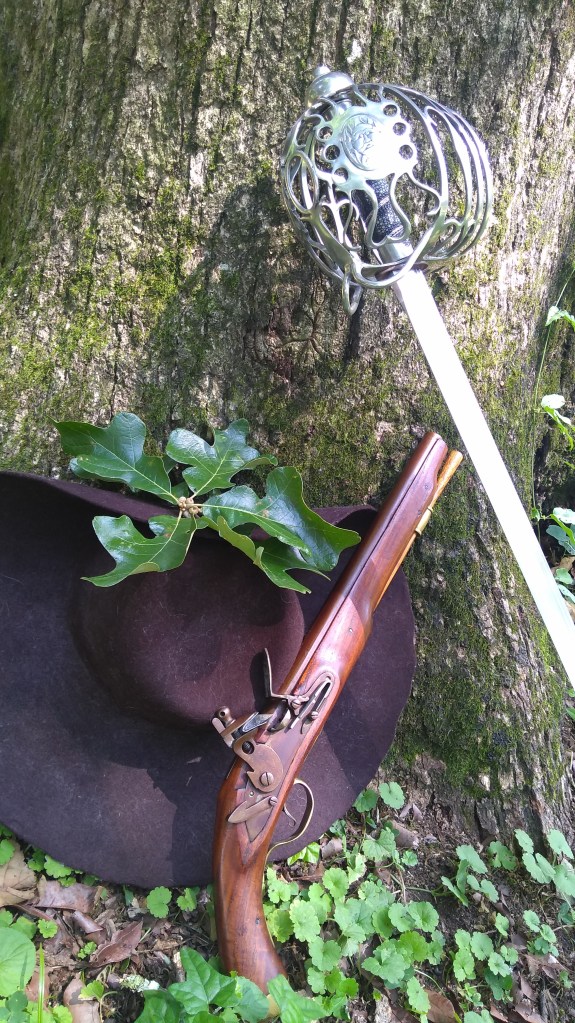
Oak leaves were a recognition device worn by many followers of the Duke of Monmouth. The pistol is a replica doglock common to the period. The hilt of the replica backsword is of a style made in both England and Scotland from the late 17th century into the 18th. Photograph by Mary E. Crouch.

Copyright Treasure Light Press LLC.

“Quo, quo, scelesti, ruitis?”

July 5, 2020: On this date, July 5, 1685 (Old Style), as he smoked his pipe and tended his geraniums, the fictional and eponymous Dr. Peter Blood flung these words after the very real Monmouth volunteers flooding into Bridgwater on the eve of the Battle of Sedgemoor. Hours later the rebels met a brutal defeat, followed by brutal pursuit and prosecution as traitors.

Many of the Monmouth rebels-convict fortunate enough to avoid the noose were transported in servitude to Barbados. One of them, surgeon Henry Pitman, escaped and via his account of his adventures ultimately provided a significant part of the inspiration for Captain Blood: His Odyssey by Rafael Sabatini.

The now-famous Latin quote is the first line of Horace’s Epode VII. Addressed to the Roman people and inspired by the continued Roman civil wars, it asks β€œWhither, whither, are you wicked men rushing?” The open book in the image is a 1650 edition of the Carmina, Epodes, and Satires of Horace–perhaps even the same well-thumbed volume kept by Peter Blood. πŸ™‚

For those of you with an eye for historical fact and detail, the modern Gregorian date, as opposed to the original old style or Julian date, for the 325th anniversary of July 5, 1685 is actually July 15, 2020.

We continue to press forward with our 100th Anniversary Annotated Edition of Captain Blood: His Odyssey!

Copyright Treasure Light Press LLC