
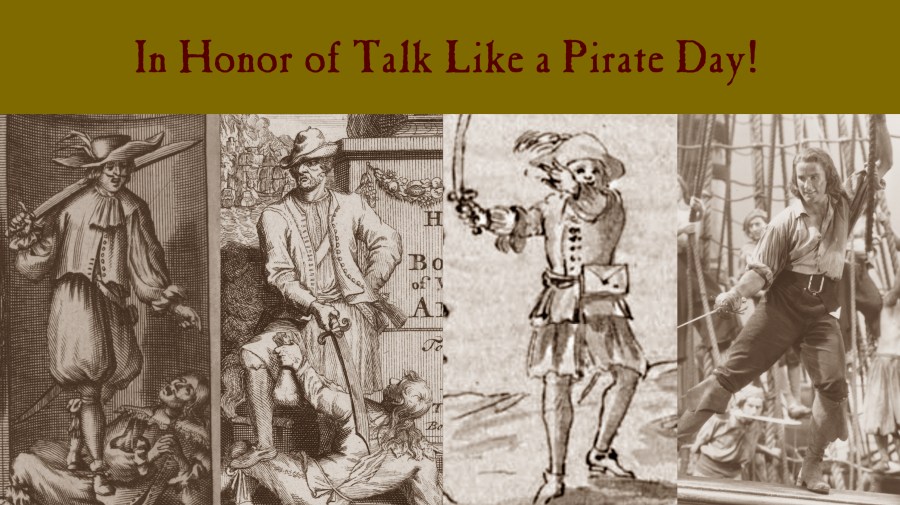
In honor of Talk Like a Pirate Day, some original, literary, and Hollywood buccaneer language of captains exhorting their crews!
“Yes, follow me and doe not lye behind, for if I doe amise* You will all fair the worse for itt.”
—Captain Richard Sawkins, English buccaneer captain, landing himself first and leading the attack against the “stokadoes” on the río Puebla Nueva (in the modern district of Remedios, Panama) in 1680, as quoted by buccaneer “E. P.,” probably Edward Povey. Sawkins “went up corragiously with some brisk men with him, butt their was provided Mollattas and hunters with their launces which came to oppose him. He fierd his Pistole and shott downe one Musteese, the rest fiering and lodeing as fast as they could, but the Spaniards coming in upon them so fast that kill’d capt. Sawkins and 3 men more.” The buccaneers were forced to take to their heels. * Probably amiss: to go amiss, to fail.
“Have a good courage. We must either defend ourselves like good soldiers, or lose our lives with all the riches we have gotten. Do as I shall do, who am your Captain. At other times we have fought with fewer men than we have in our company at present, and yet we have overcome greater numbers than there possibly can be in this town. The more they are, the more glory we shall attribute unto our fortune, and the greater riches we shall increase unto it.”
—Captain François L’Ollonois, aka Jean David Nau, prior to the attack on Gibraltar on Lake Maracaibo in 1666, as quoted by Alexandre Exquemelin, buccaneer-surgeon and buccaneer chronicler who likely sailed under him, from the 1684 English edition (Crooke) of The Buccaneers of America. The speech, while it might be authentic, might also be embellished, recreated and revised from poor memory, or even apocryphal, added after the fact for editorial emphasis. L’Ollonois, a bloody-minded buccaneer and murderer, was killed by Native Americans on the Darien coast in 1669, burned, and his ashes reportedly scattered to the wind.
“You are too experienced to not understand the peril we are running, and too brave to fear it. It is necessary here to be cautious of all yet to risk all, to defend and attack at the same time. Valor, deception, fear, and even despair must all be put to use on this occasion; where, if we fall into the hands of our enemies, nothing awaits us but all sorts of infamies, from the most cruel of torments to, finally, the end of life. We must therefore escape their barbarity; and to escape, we must fight.”
—Captain Laurens de Graff, Dutch buccaneer in the service of French flibustiers, prior to his fight against the Capitana and Almirante of the Armada de Barlovento in 1685, each ship twice the size of de Graff’s Neptune and throwing twice its weight in iron, as quoted (and perhaps embellished, and clearly edited) by Alexandre Exquemelin in the French edition of The Buccaneers of America. De Graff was later wounded in the action, but ordered his men to carry him back on deck when he noticed his ship’s guns slacking their fire. The Spanish men-of-war took enough of a beating that they fled the scene overnight. (My translation.)
“On, now, Jeremy!” cried Blood. “Straight into them before they recover their wits. Stand by, there! Prepare to board! Hayton … the grapnels! And pass the word to the gunner in the prow to fire as fast as he can load. … Musketeers to the prow!”
—the fictional Captain Peter Blood in Captain Blood: His Odyssey by Rafael Sabatini (1922), during the finale against the French fleet at Port Royal, Jamaica, set in the year 1689.
“All right, my hearties, follow me!”
—Errol Flynn as the fictional Captain Peter Blood in Captain Blood (Warner Bros., 1935, Casey Robinson screenwriter) during the finale against the French fleet at Port Royal, Jamaica, from the gun’l, his ship sinking, just before he swings Hollywood-style from ship to ship, leading his men in a boarding action. The line is not in the published script, but apparently was written or adlibbed during filming. The original line was “Over we go, lads!” Flynn also uses much of Sabatini’s language above prior to boarding.
The probably French buccaneer on the far left in the illustration above is a detail from De Americaensche Zee-Roovers by A. O. Exquemelin, 1678, in the Library of Congress; the probably Dutch buccaneer at left center is a detail from Historie der Boecaniers, of Vrybuyters van America by Alexandre Exquemelin, 1700; the French buccaneer at right center is an eyewitness illustration, that is, what one truly looked like, a detail from a chart of Petit Goave drafted in 1688 by Paul Cornuau, Archives Nationale d’Outre-Mer; and on the far right is Errol Flynn in a detail from a publicity still for Captain Blood, Warner Bros. 1935.
Copyright Benerson Little 2024. First published September 19, 2024.
 Treasure Light Press